Sep 16, 2026Memory Foam Pillows
What Does a New Memory Foam Pillow Smell Like?
A new memory foam pillow may have a mild manufacturing odor. Learn what buyers should know about water-blown foam, methylene chloride and foam quality.
What Does a New Memory Foam Pillow Smell Like?
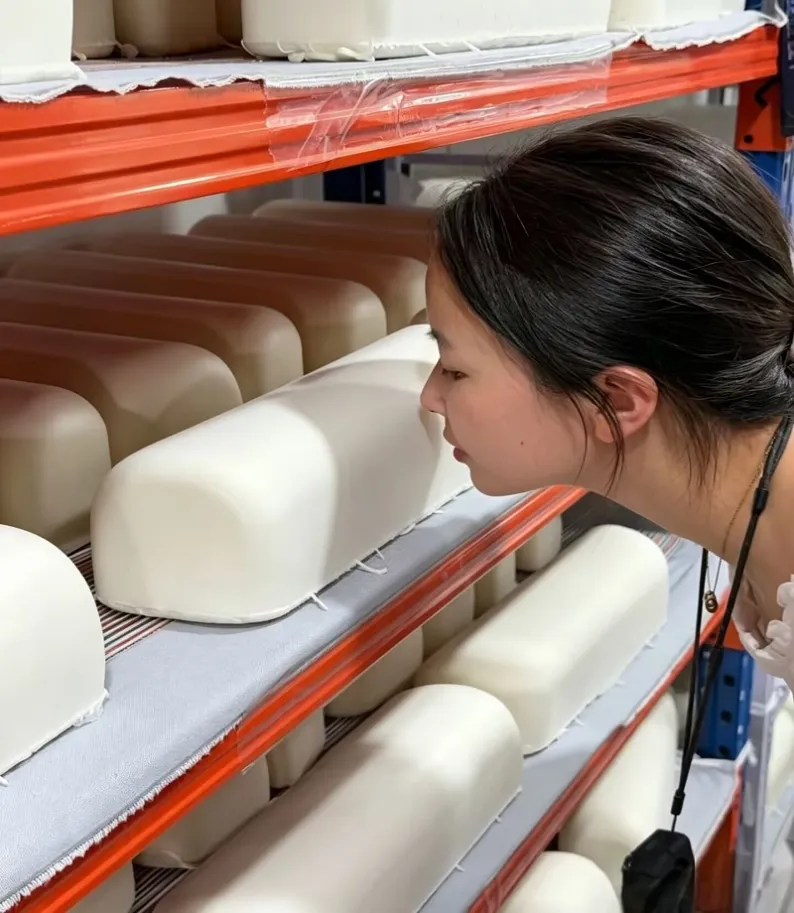
Open a brand-new memory foam pillow.
You may notice a smell.
Sometimes it is very light, like a new foam or new furniture smell. Sometimes it is stronger and more difficult to describe.
For consumers, this may simply be annoying.
But for brands and B2B buyers, the smell can also raise another question:
What is actually inside the foam?
This is a topic worth discussing before choosing a memory foam pillow supplier.
Not every new foam smell means the same thing
Memory foam is a type of polyurethane foam made from a chemical reaction involving polyols, isocyanates, catalysts, surfactants and other formulation components.
Water can play an important role in the foaming process.
When water reacts with isocyanate, carbon dioxide (CO₂) is generated. This CO₂ helps expand the polymer and form the foam cells. This process is commonly called water-blown foam.
So, a newly produced memory foam pillow can have a mild manufacturing smell.
The exact smell can vary depending on the formulation, processing, curing, packaging and storage conditions.
This is why I would not use smell alone to judge whether a pillow is good or bad.
What about methylene chloride?
There is another term that B2B buyers may come across:
Methylene chloride, also called dichloromethane (DCM).
Historically, methylene chloride has been used as an auxiliary blowing agent in flexible polyurethane foam production. It works differently from water-blowing: instead of being generated through the polyurethane reaction, it can vaporize from the heat of the reaction and contribute to foam expansion.
Methylene chloride is a volatile chemical with a characteristic sweet or chloroform-like odor.
It is also a chemical that needs proper handling and emission control. EPA regulations have specifically addressed methylene chloride emissions from flexible polyurethane foam production and fabrication.
This is why the manufacturing process matters.
But there is one important point:
You cannot identify methylene chloride in a pillow simply by smelling it.
A sweet or solvent-like smell can be a reason to ask more questions, but odor alone is not a chemical test.
Why should B2B buyers care about odor?
Because a pillow is different from many other foam products.
It is used close to the face.
It may stay next to the consumer for many hours.
And for an online bedding brand, the first experience can start the moment the customer opens the package.
If the pillow has a strong chemical or solvent-like smell, the customer may immediately question the quality of the product.
Even if the foam eventually performs well, a poor first impression can still affect the customer experience.
For a brand, this matters.
The product experience starts before the first night of sleep.
Water-blown foam does not mean “no smell”
This is another point I think buyers should be careful about.
It would be too simple to say:
“Water-blown foam has no smell.”
That is not necessarily true.
A polyurethane foam formulation contains more than just water and isocyanate. Catalysts, surfactants and other components can also affect the final foam and its odor.
The finished product can also pick up odors from curing, storage, packaging or other materials.
So instead of asking:
“Does it smell?”
I would ask:
“What is causing the smell, and how is the foam produced?”
That is a much more useful question.
Odor is only one part of foam quality. You can also read our guide on how to evaluate memory foam pillow quality.
How can buyers check a memory foam pillow?
Before placing a large order, I recommend asking the supplier a few simple questions:
What type of foam formulation do you use?
What is the main blowing system?
Are auxiliary blowing agents used?
How is the foam cured and stored before packing?
Can you provide a physical sample for evaluation?
Then test the sample yourself.
Open the packaging.
Check the initial odor.
Let it ventilate under normal conditions.
Check the recovery speed.
Feel the foam.
Measure the density.
Compare it with samples from other suppliers.
If you need specific chemical or emissions requirements for your target market, ask the supplier for the relevant test documentation rather than relying on smell alone.
The smell is only one part of foam quality
A good memory foam pillow should not be judged by odor alone.
Foam density, firmness, recovery speed, cell structure, shape stability and manufacturing consistency all matter.
And for B2B buyers, there is another important point:
The foam specification should match the whole product and distribution process.
A pillow that will be vacuum packed, shipped by sea and stored for a long period may need different development considerations from a pillow sold locally without long-term compression.
This is why I prefer to discuss the complete product requirement with buyers instead of simply offering a standard pillow and a price.
Developing a Memory Foam Pillow for Your Brand?
If you are developing a new memory foam pillow, we can discuss the foam formulation, density, recovery speed, firmness, shape, cover and packaging requirements with the factory.
If odor, foam type or blowing system is an important requirement for your market, tell us your target specification before sampling.
We can discuss the production options and develop a sample for your project before mass production.
Send us your requirements and let's start with the sample.
More related pages:
📩 Send us your project needs or specifications, and we will respond with a clear quotation and production suggestion within 24 hours.
Email: info@hengmy.com