Oct 8, 2026Weighted Blankets
How Much Filling Goes Into a Weighted Blanket?
Learn how weighted blanket filling is calculated from total weight, filling weight, pocket count and filling per pocket, with practical points for product development.

How Much Filling Goes Into a Weighted Blanket?
When developing a weighted blanket, one of the first questions is:
How much filling should go inside the blanket?
It sounds simple, but the answer is not just the number shown as the finished blanket weight.
For product development, there are several steps to consider:
Total Weight → Filling Weight → Number of Pockets → Filling per Pocket
Understanding this process helps avoid mistakes when developing a new weighted blanket.
Start with the target finished weight
The first specification is usually the target weight of the finished blanket.
For example, a buyer may request a specific finished weight for a certain size.
But there is an important point:
Finished weight is not the same as filling weight.
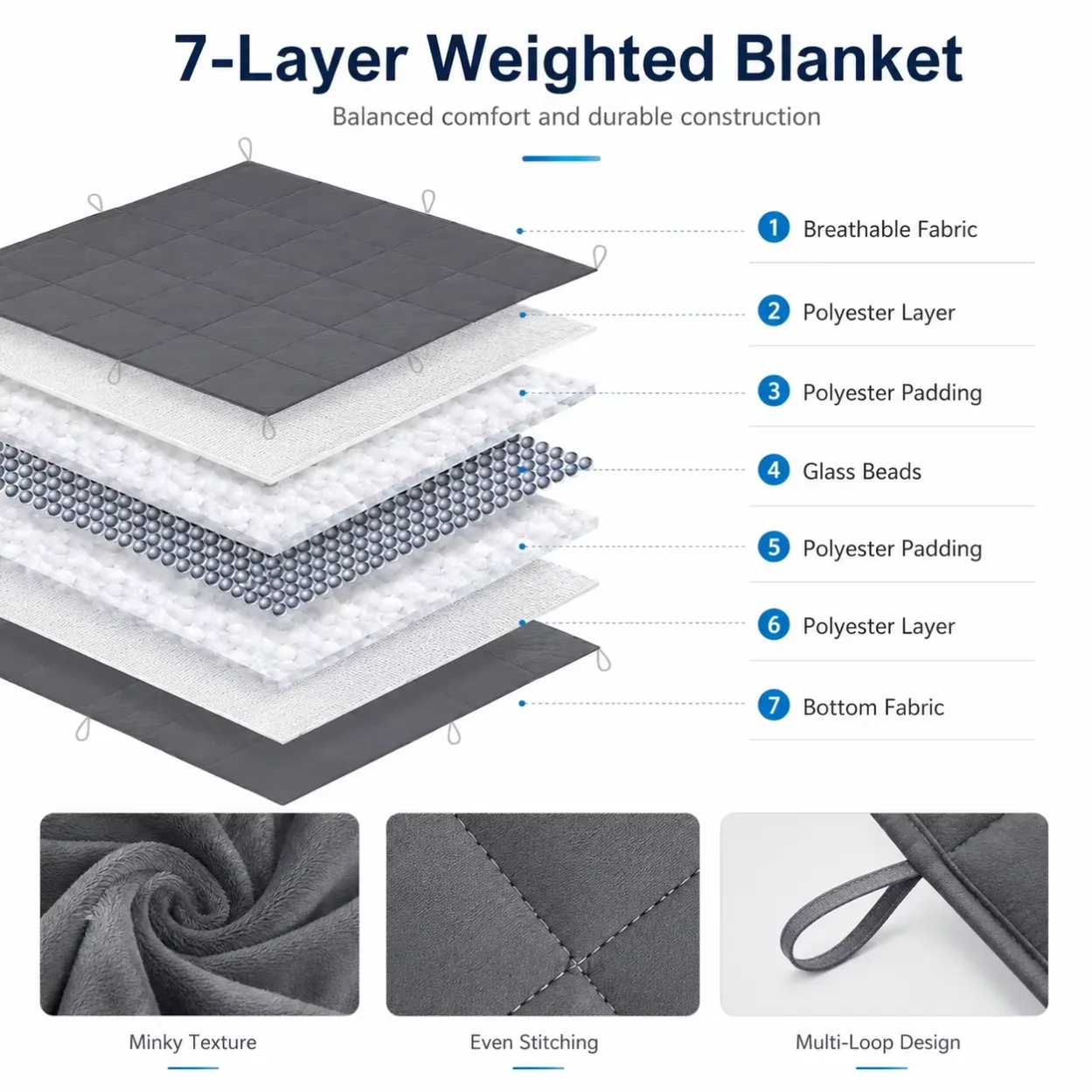
The finished blanket also includes the outer fabric, inner layers, thread, labels and other construction materials.
So the amount of weighted filling needs to be determined after considering the weight of the other components.
This is why a supplier should not simply take the finished blanket weight and treat the whole amount as glass beads.

Determine the actual filling weight
Once the other materials are considered, the remaining weight is the approximate amount available for the weighted filling.
In simple terms:
Finished Weight − Other Material Weight = Filling Weight
This is the starting point for calculating how much glass bead filling is needed.
The exact result depends on the product construction.
A blanket with a thicker outer fabric and additional inner layers will naturally have a different filling requirement from a simpler construction, even when the finished blanket size and target weight are the same.
So filling weight should be confirmed during product development and sampling rather than estimated only from the finished weight.
The number of pockets changes the calculation
After the filling weight is decided, the next question is:
How many pockets will the blanket have?
This depends on the blanket size and the pocket construction.
There is no single pocket count that works for every weighted blanket.
A blanket can use smaller or larger quilted sections, depending on the design and production requirements.
The important point is that the filling needs to be divided across the intended filled pockets in a controlled way.
This is what connects the total filling weight to the actual production process.
Calculate the filling per pocket
The basic calculation is straightforward:
Total Filling Weight ÷ Number of Filled Pockets = Filling Weight per Pocket
For example, if a development sample requires a certain total filling weight and that filling is divided into 100 equal pockets, the total filling weight is simply divided by 100.
The actual number of pockets can be different from this example. The purpose is only to show the production logic.
In production, each pocket needs a controlled amount of filling so the finished blanket does not have noticeably heavier or lighter areas.
This is also why filling should be measured during production rather than added by rough estimation.
Pocket size and filling amount need to match
There is another important point.
You cannot decide the filling amount per pocket without considering the pocket size.
If the pocket is small, the available space for filling is limited.
If the pocket is larger, there is more room for the filling to move inside the section.
So the development process is not simply:
How much filling do we need?
It is:
How much filling do we need, and how should that filling be divided inside the blanket?
The filling does not need to be identical in every product
Different blanket sizes and weights require different filling amounts.
A smaller blanket with a lower target weight will naturally require less filling than a larger and heavier blanket.
The filling material can also affect the required volume. For example, glass beads and plastic pellets do not occupy exactly the same amount of space for the same weight.
This is one reason why filling material should be confirmed before the pocket construction is finalized.
The product should be developed as a complete system rather than calculating the filling separately.
Sampling is where the calculation becomes practical
The calculation gives a starting point, but the sample is still important.
During sampling, the actual blanket can be checked for finished weight, filling distribution, pocket construction and overall thickness.
If the finished weight is correct but the filling distribution does not feel right, the pocket construction may need to be reviewed.
If the construction is correct but the final weight is not within the target, the filling amount may need adjustment.
This is normal in product development.
The goal is not only to calculate the correct amount of filling on paper. It is to make sure the filling, pocket construction and finished product work together.
Final Thoughts
The amount of filling in a weighted blanket should not be decided by finished weight alone.
A more practical development process is:
Target Finished Weight
↓
Calculate Filling Weight
↓
Confirm Number of Filled Pockets
↓
Calculate Filling per Pocket
↓
Make and Check the Sample
This approach gives buyers and manufacturers a clearer starting point for discussing a new weighted blanket.
If you are developing a private label weighted blanket and already know the size, target weight and preferred pocket construction, send us these basic details. We can work through the filling requirement and construction together before sampling.
More related pages:
📩 Send us your project needs or specifications, and we will respond with a clear quotation and production suggestion within 24 hours.
Email: info@hengmy.com